
Dr. Roberto De Ronzi
Karate Master, Educator, and Expert in Martial Arts & Self-Defense
Dr. Roberto De Ronzi is a distinguished figure in the world of martial arts and physical education. With a degree in Exercise and Sport Sciences, he combines academic knowledge with decades of practical experience to inspire growth, discipline, and resilience through martial arts. A Karate Master (5th Dan, FIJLKAM) and Ju Jitsu Master (6th Dan, FIJLKAM), Dr. De Ronzi has dedicated his career to teaching, training, and mentoring students across all levels. Beyond the dojo, Dr. De Ronzi has served as an instructor of self-defense and operational techniques for police forces. Over the years, he has held numerous teaching and technical roles within FIJLKAM and other professional training contexts. His approach blends tradition with innovation, promoting martial arts as pathways to self-control, respect, social development, and lifelong learning.
Dr. De Ronzi is also a co-author of several scientific publications in physical education, martial arts, and sport sciences. He has collaborated with Dr. Gianpiero Greco on a groundbreaking study demonstrating the positive impact of Karate training on social, emotional, and executive functioning in children with autism spectrum disorder. Dr. De Ronzi continues to advance the role of martial arts as a powerful educational and developmental tool by helping individuals unlock their potential both inside and outside the dojo.
Effect of Karate Training on Social, Emotional, and Executive Functioning in Children with Autism Spectrum Disorder
Summary of the Research Article published in the Journal of Physical Education and Sport, 2020.
DOI: 10.7752/jpes.2020.04223
Karate is more than a martial art as it is a pathway to growth, resilience, and empowerment. This study explored the profound benefits of Karate training for children with autism spectrum disorder (ASD), with particular emphasis on social, emotional, and executive functioning. ASD can present challenges in communication, behaviour, social interaction, emotional regulation, and adaptability. For this reason, structured activities that combine movement, discipline, repetition, and social connection may serve as powerful educational tools that inspire progress and confidence.
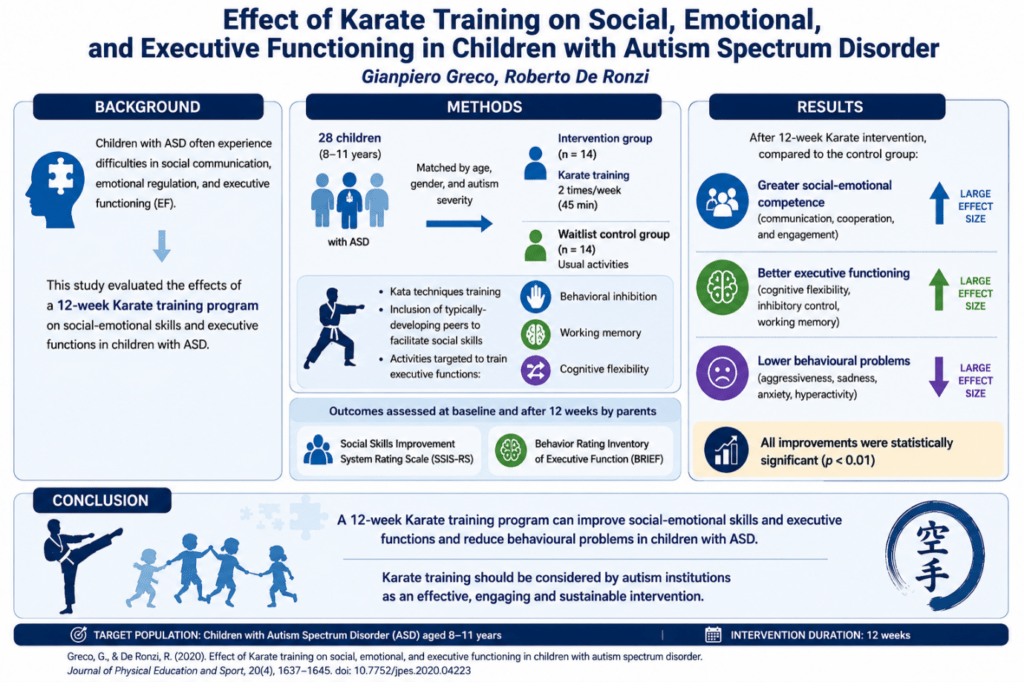
The research examined the impact of a 12-week Karate training program for children aged 8 to 11 years with ASD. Twenty-eight children participated, divided into an intervention group and a waitlist control group. Those in the Karate group trained twice weekly for 45 minutes, practicing Kata techniques in a structured, supportive, and inclusive environment.
The program included fundamental Karate movements, breathing exercises, warm-up routines, and progressive Kata learning. Training was designed not only as physical exercise but also as a holistic approach to strengthen attention, behavioural control, working memory, cognitive flexibility, emotional regulation, and social interaction.
Key Findings
- Improved social skills: Children demonstrated stronger communication, cooperation, engagement, and self-control.
- Enhanced executive functioning: Gains were observed in cognitive flexibility, inhibitory control, working memory, and behavioural regulation.
- Reduction in problem behaviours: Aggressiveness, sadness, anxiety, hyperactivity, and impulsivity decreased.
- High adherence and acceptance: The program was embraced by children and families, with parents expressing strong interest in continuing beyond the study.
These findings highlight that Karate training offers far more than physical benefits. Its structured routines, respect for rules, instructor guidance, and peer interaction create a nurturing environment for children with ASD. Through Kata practice, children learn to focus attention, remember sequences, control movements, follow instructions, and adapt behaviour- skills that directly support executive functioning and everyday socio-emotional growth.
Educational and Practical Implications
The study underscores Karate as a powerful educational and developmental activity for children with ASD. Beyond motor skills, Karate nurtures self-regulation, communication, cooperation, and emotional control.
- For martial arts teachers: The research emphasizes the importance of structured, patient, and inclusive learning environments. Clear instructions, repetition, calm communication, and progressive teaching enable children with ASD to thrive and benefit fully from training.
- For families and educators: Karate represents a meaningful activity that blends physical movement, discipline, social interaction, and personal growth. It can be integrated into broader educational and recreational programs aimed at supporting the well-being of children with ASD.
Conclusion
Karate training emerges as a promising tool to strengthen social, emotional, and executive functioning in children with ASD. The study by Greco and De Ronzi demonstrates that a structured 12-week program can significantly enhance social competence, emotional regulation, behavioural control, and executive functioning.
Beyond the practice of techniques, Karate instils discipline, respect, self-control, attention, and meaningful interaction – qualities that extend far beyond the dojo. Martial arts, when taught with care and inclusivity, can play a vital educational role and contribute to the holistic development and well-being of children with autism spectrum disorder.